
6-Week Transabdominal Ultrasound: What You Can See (Heartbeat Flutter, Fetal Pole Size, and Why the Yolk Sac Matters)
Updated: Oct 1
If you’re around 6 weeks pregnant, this is often one of the most meaningful early milestones. It’s the stage when the pregnancy can start to look more “real” on ultrasound.
At True Ultrasound, many parents come in for reassurance and connection. One of the most emotional moments of this visit is seeing the flutter of the heartbeat. I often include a short video clip of it so you can take that moment home with you.
This guide explains what we typically see at 6 weeks, what the measurements mean, how moms often feel, why prenatal vitamins matter, and how to prepare (especially for a transabdominal ultrasound).
Important: True Ultrasound provides elective ultrasounds for bonding and reassurance. This is not diagnostic and does not replace prenatal care or medical ultrasound with your OB/GYN or provider.
What We Typically See at 6 Weeks on Ultrasound
Around 6 weeks, an ultrasound often shows:
1) Gestational Sac
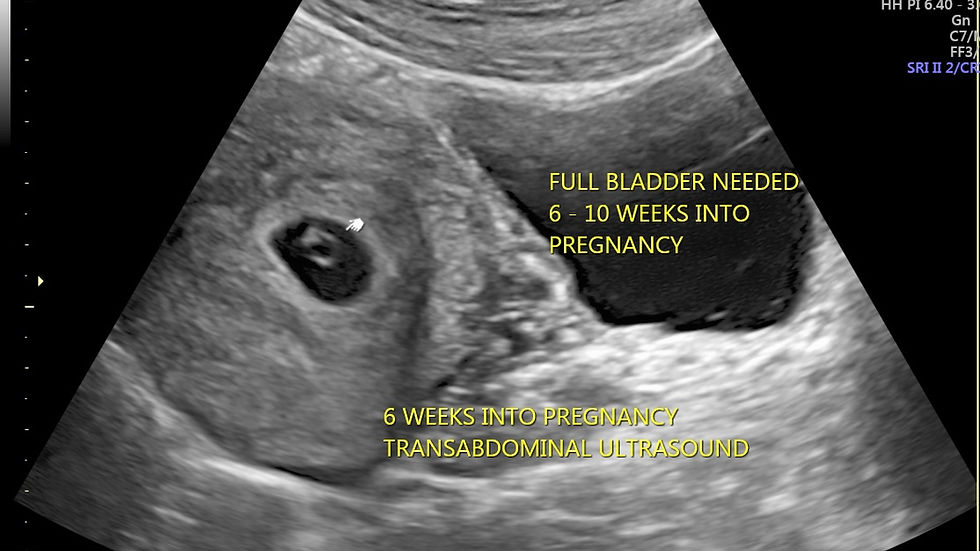
This is the first “home” we look for inside the uterus. It usually appears as a dark, fluid-filled round or oval shape with a bright rim.
2) Yolk Sac
The yolk sac is a small circular structure inside the gestational sac. It supports early development before the placenta takes over completely. (More on why its size matters below.)
3) Fetal Pole (the Embryo)
The fetal pole is the early embryo. It is commonly measured as CRL (crown–rump length).
4) Heartbeat Flutter (Cardiac Activity)
At about 6 weeks, early fetal heart activity is often visible. In our clinic, we can usually capture it transabdominally with good preparation and accurate dates. A classic study used 100 bpm up to 6.2 weeks and 120 bpm at 6.3 to 7.0 weeks as lower limits of normal.
How Moms Often Feel at 6 Weeks
This is the stage when many moms say: “I feel pregnant… but also not pregnant.” Symptoms can change day to day.
Common feelings at 6 weeks include:
Fatigue (the “I need a nap” phase)
Nausea or food aversions (or sometimes none yet)
Breast tenderness
Bloating
Increased urination
Mild stretching or cramping sensations
Anxiety (very common—especially before the first heartbeat visit)
A reassuring truth: symptoms don’t always match what you see on an ultrasound. Some people feel intense symptoms early; others feel very little and still have a normal pregnancy experience.
Why Prenatal Vitamins Matter
Early pregnancy is when major structures begin forming. This is why prenatal vitamins, especially folic acid, matter so much.
ACOG recommends a prenatal vitamin with at least 400 mcg (0.4 mg) of folic acid daily.
The CDC emphasizes 400 mcg daily to help prevent neural tube defects (brain/spine development).
The USPSTF recommends 0.4–0.8 mg (400–800 mcg) daily for people who could become pregnant.
Prenatals help cover key nutrients during the weeks when the baby’s foundations are being built, especially folic acid for early neural tube development.
What is a “Normal” Heartbeat at 6 Weeks?
Heart rate increases rapidly in early pregnancy. When the heartbeat first becomes visible, a commonly referenced range is around 100–120 bpm.
Around 6 weeks, you may see a heart rate in the ~100–120 bpm range.
It typically rises over the next couple of weeks.
Note: We keep the experience reassuring and educational, but heart rate interpretation and viability questions should always be discussed with your medical provider.
How Many Millimeters is the Fetal Pole at 6 Weeks?
The fetal pole (embryo) is measured as CRL (crown–rump length).
A practical, informative way to explain it:
The embryo grows about ~1 mm per day around this stage.
That’s why 6 weeks can look different for different people: being off by even 3–4 days can change what you see.
What is the Embryo Comparable To?
Use these easy comparisons (parents love these):
1–2 mm: poppy seed / tiny grain
3–4 mm: sesame seed
5–7 mm: a small lentil
At this stage, your baby is incredibly tiny—often comparable to a sesame seed or small lentil, depending on the exact day.
Why Yolk Sac Size Matters
The yolk sac is important because it’s one of the earliest supportive structures of pregnancy. It can be a reassuring sign when it looks normal.
Typical yolk sac diameter: about 3–5 mm. When it can be concerning: many references note that >6 mm may be associated with a higher chance of abnormal pregnancy outcomes.
Also, it’s not just size; we look at:
Shape (usually round)
Regular, smooth appearance
Yolk sac size is one of the early measurements we note because it can provide helpful context. However, it’s not used alone to make medical decisions. Your OB/GYN/provider should always interpret findings in the full clinical picture.
Why a Full Bladder Helps at 6 Weeks (Transabdominal)
In early pregnancy, the uterus sits lower in the pelvis. A full bladder acts like a natural “window,” making the uterus easier to visualize during a transabdominal scan.
Best Full-Bladder Prep (Simple Steps)
30–45 minutes before your appointment:
Empty your bladder.
Drink 32 oz of water.
Don’t use the restroom until after your scan (as long as you’re comfortable).
If you’re too uncomfortable, let us know, and we can adjust.
What If Someone Doesn’t See Everything at 6 Weeks?
Even though 6 weeks is often a very reassuring visit, exact dating can be off. If someone ovulates later than expected, they might be earlier than they think.
If the view is limited or the timing is early, many providers recommend a repeat scan in about 7–10 days, as development changes rapidly at this stage.
Quick FAQ
Is it Normal to Only See a Sac at 5 Weeks?
Yes, at 5 to 5.6 weeks, it's normal only to see the gestational sac and maybe the yolk sac.
Does an Elective Ultrasound Replace My OB’s Ultrasound?
No. Elective scans are for bonding/reassurance and do not replace prenatal care or diagnostic imaging.
When Should I Call My OB/GYN Right Away?
Heavy bleeding, severe one-sided pain, fainting/dizziness, fever, or worsening pelvic pain should be evaluated urgently.
Book Your Early Pregnancy Ultrasound at True Ultrasound
If you’re 6–10 weeks, come prepared with a full bladder for the best transabdominal view. We’ll walk you through what you’re seeing in a calm, supportive environment. When visible, we often capture a heartbeat flutter video as a keepsake.
📍 True Ultrasound — Lake Forest, Orange County, CA
📲 Book online or message us with questions.
Disclaimer: True Ultrasound provides elective ultrasound services and does not diagnose or treat medical conditions. Please continue prenatal care and follow your OB/GYN's or healthcare provider's guidance.
If you’re around 6 weeks and would love an extra opportunity to see your pregnancy developing, explore our Early Reassurance Ultrasound in Orange County.


Comments